Revisiting Class 6 Mathematics
- Sets (Types, Methods of representation, sets of numbers, symbols, Venn diagrams)
- Numbers (Number systems, Integers, Fractions, Decimals, Factors, Powers, Roots)
- Arithmetic's (Ratio, Percentage, Profit/ Loss, Simple Interest)
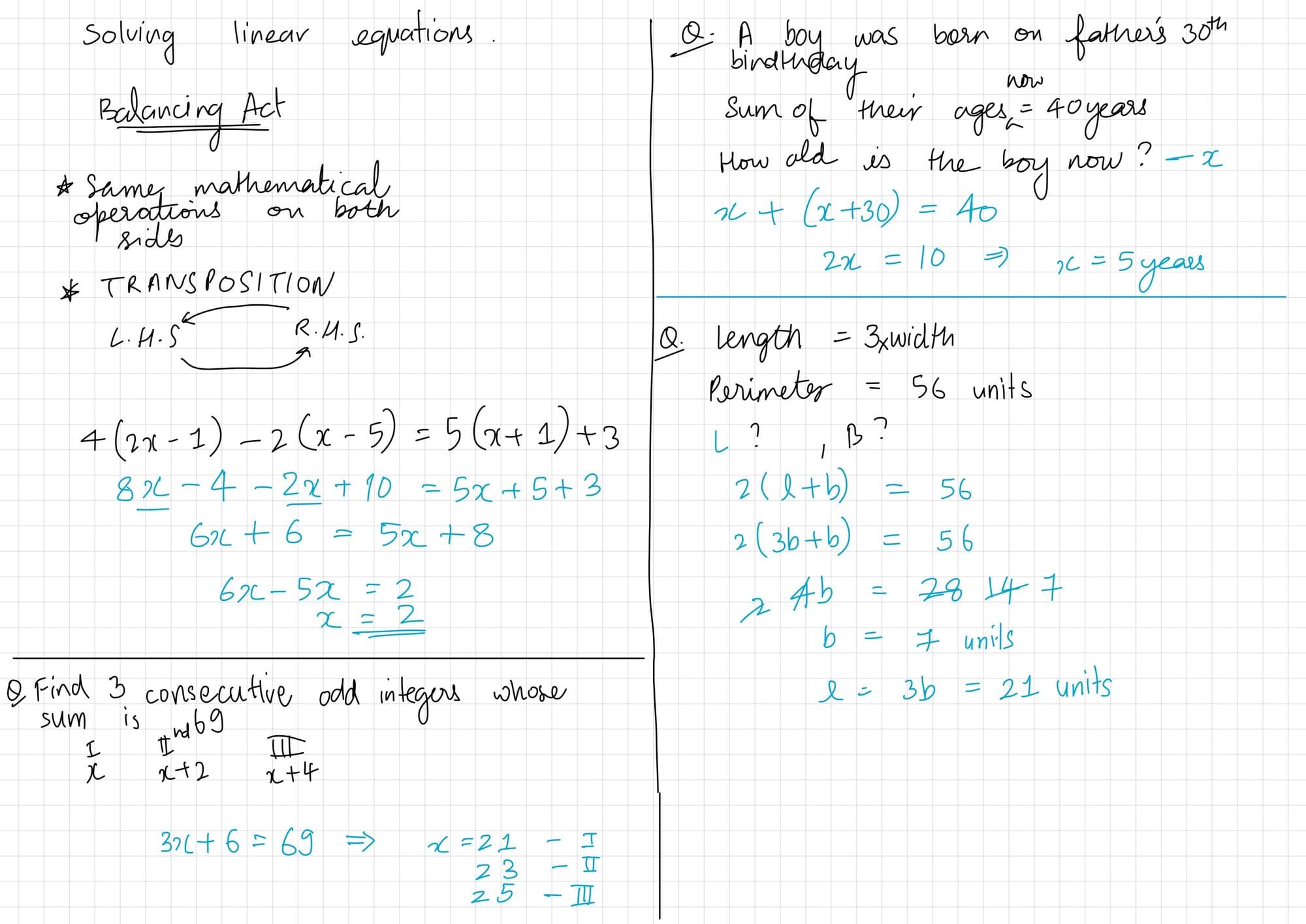
- Algebra (Concepts, Operations, Substitution, Linear equations, formula making)
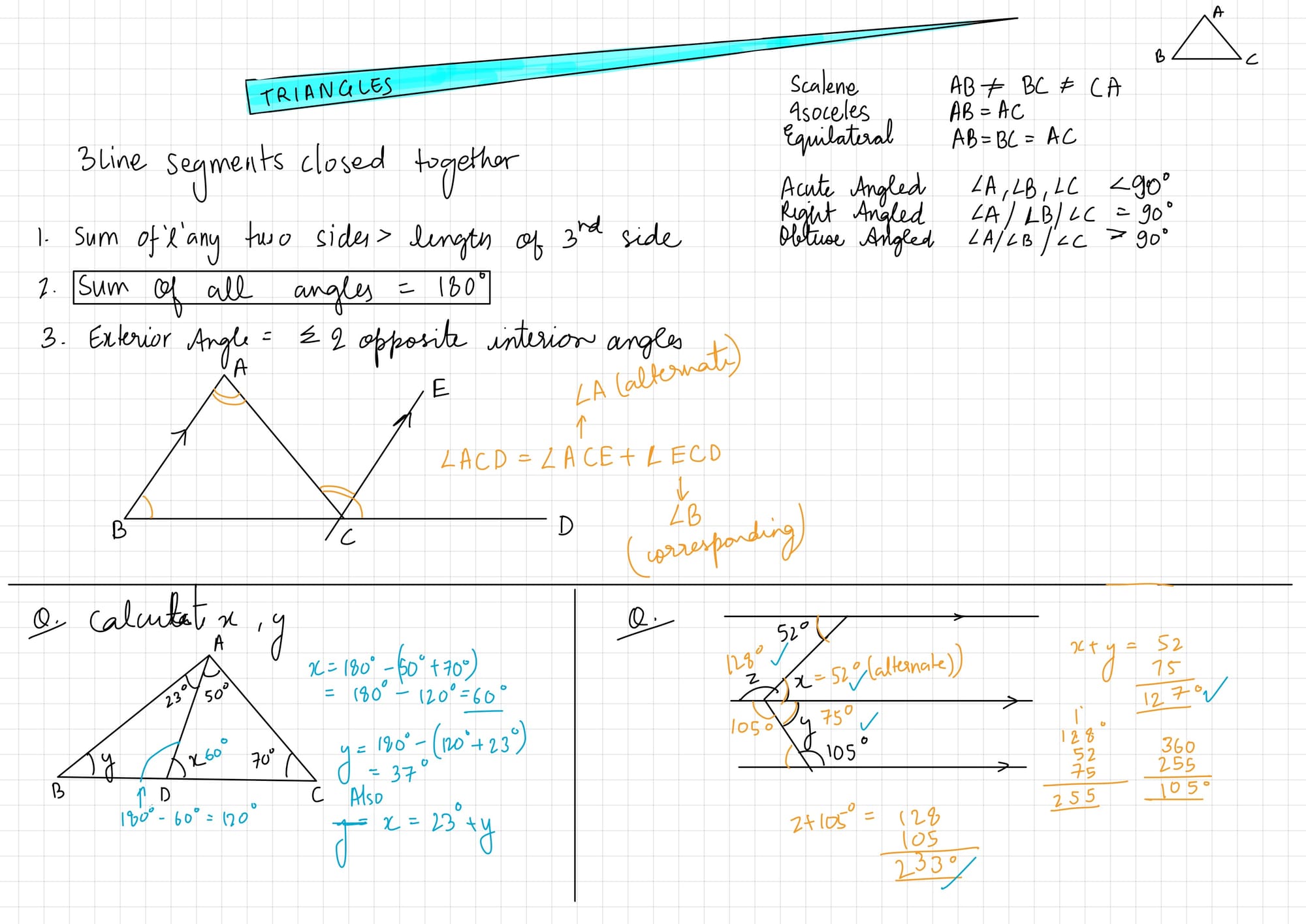
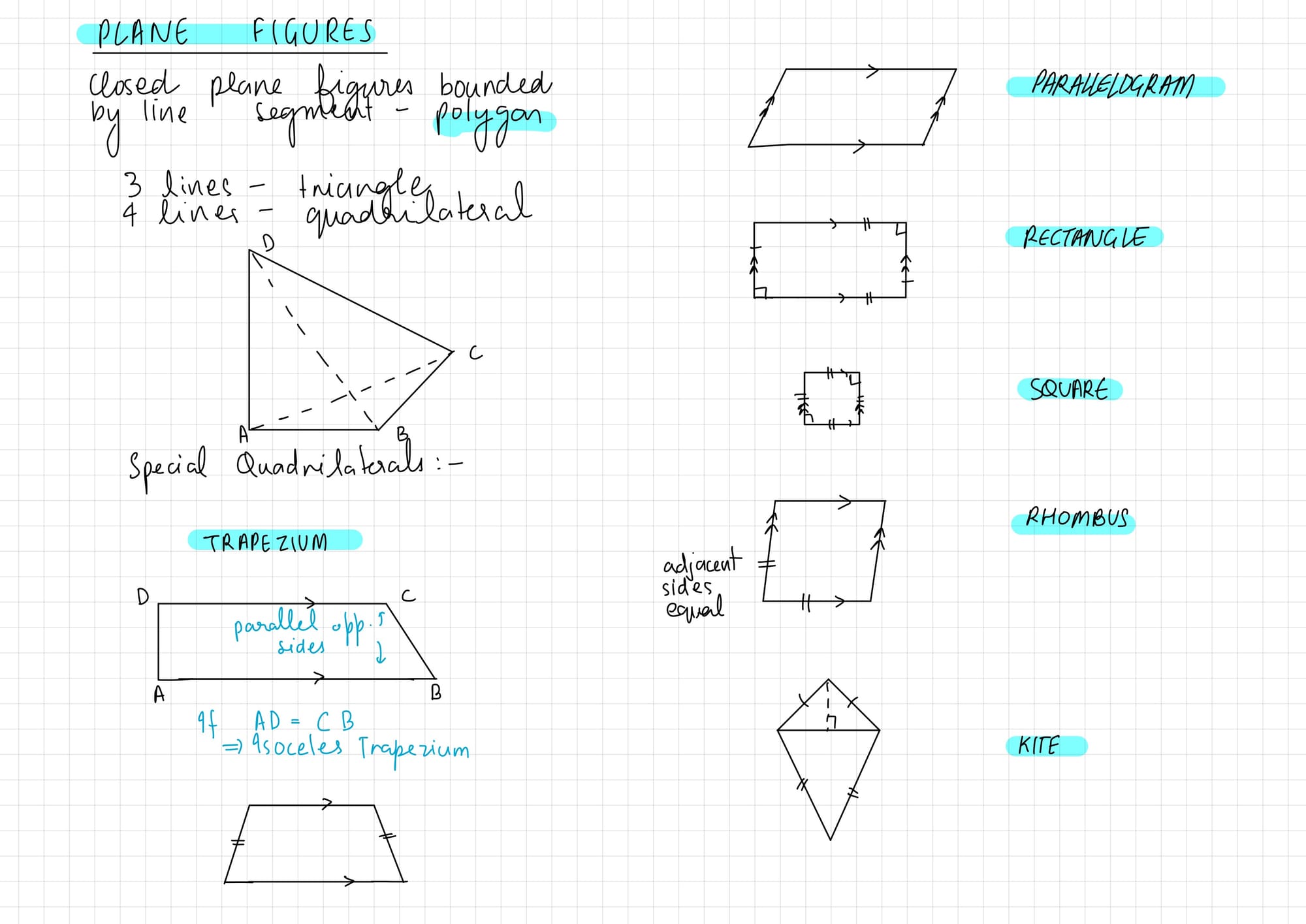
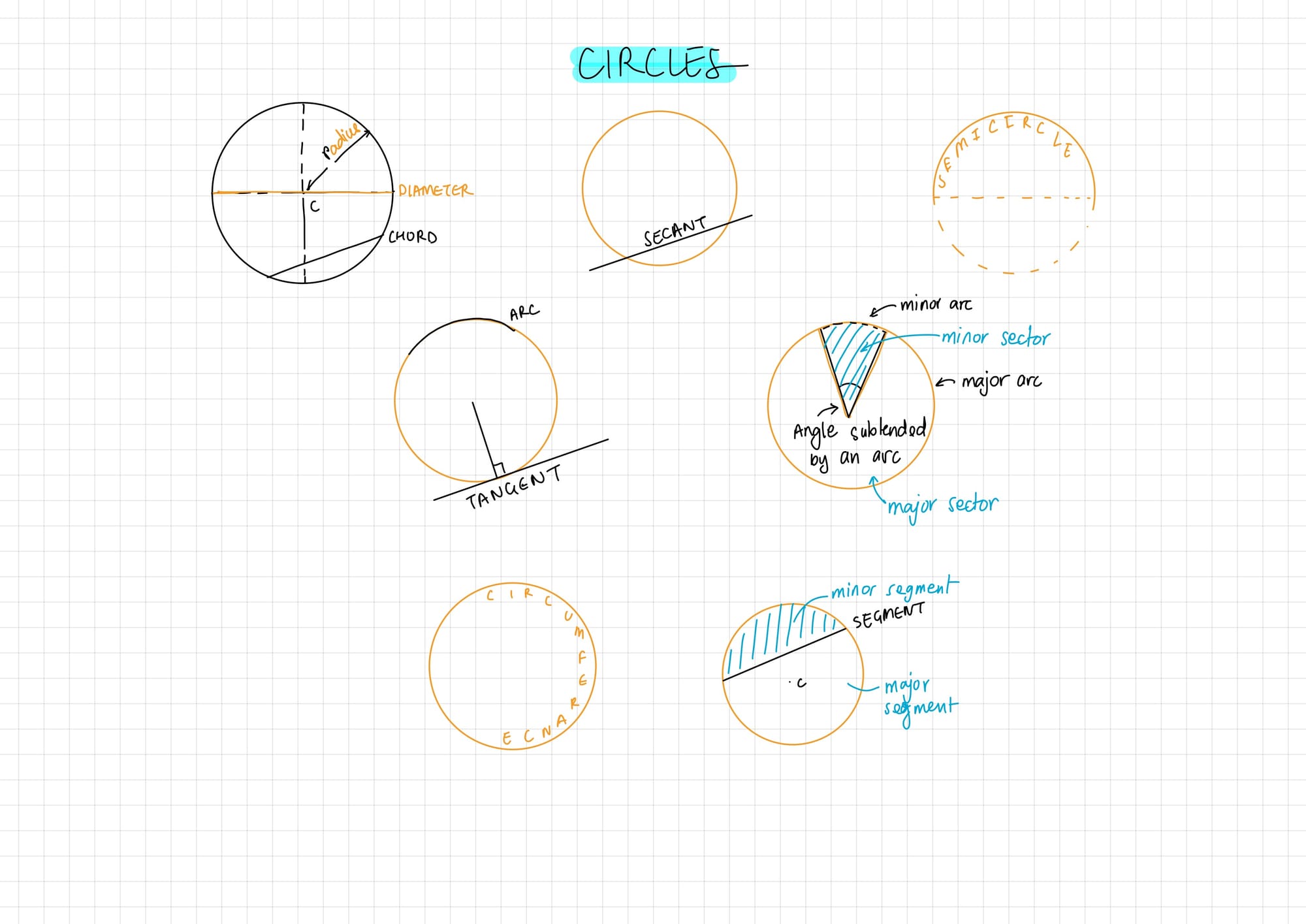
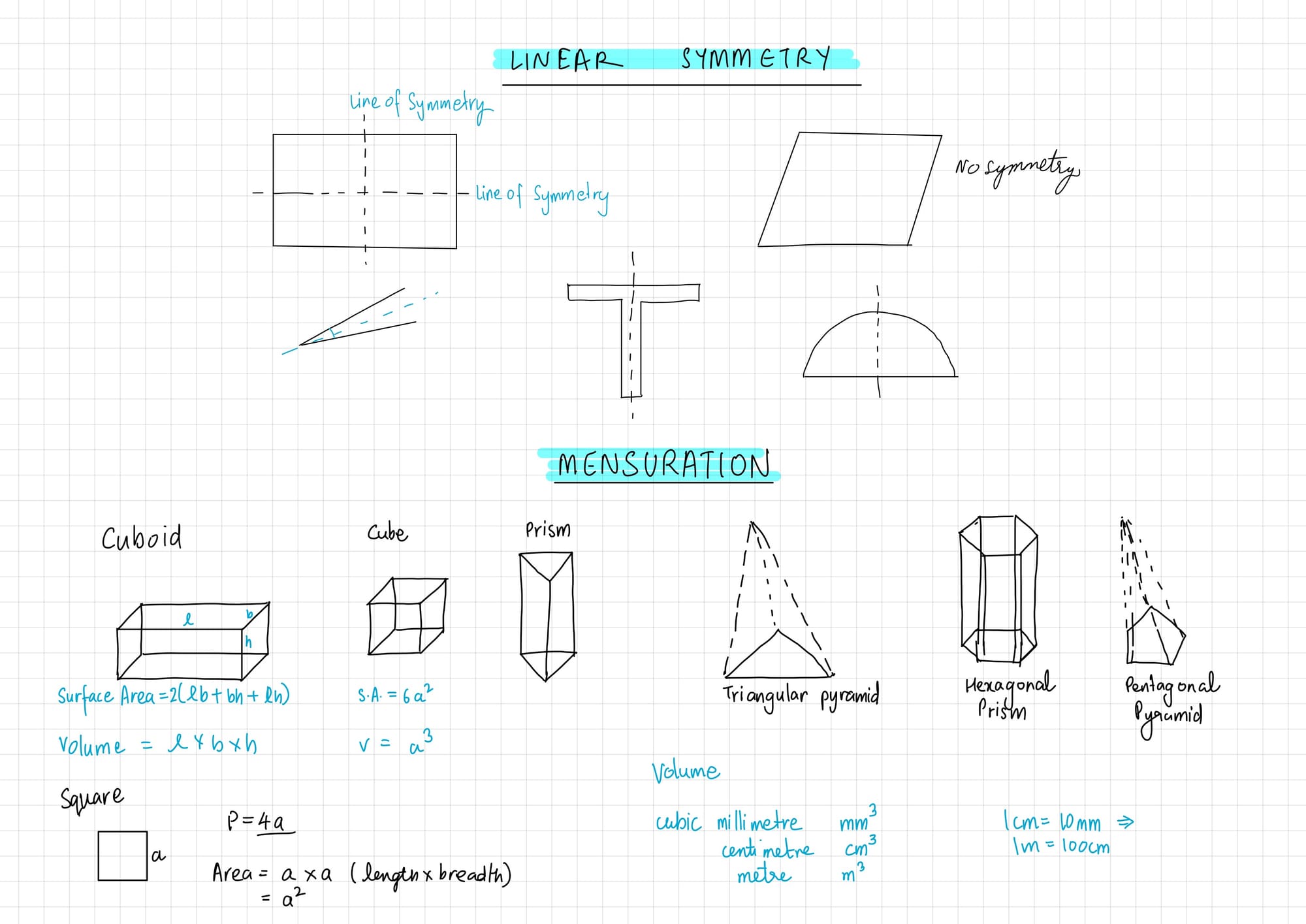
- Geometry (Concepts, Lines, Angles, Types Properties, Construction, Triangles, Circles, Symmetry)
- Mensuration (Solids, Perimeter, Area, Volume, Surfaces)
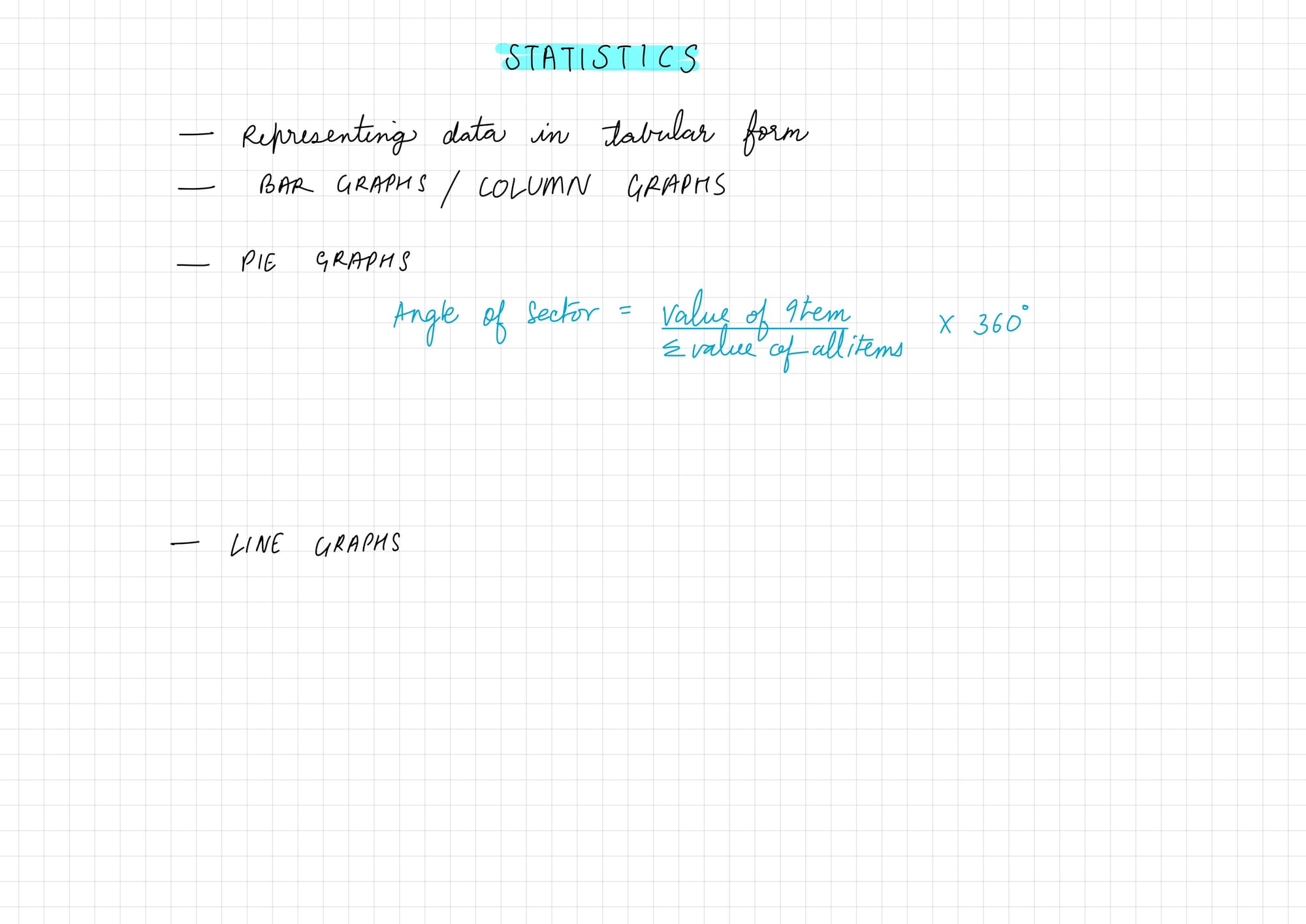
- Statistics (
1) Sets, operations and intro to Venn diagrams.
(Significance: Data Sets)
Sets are any collection of well defined objects (Eg: all days in a week). Objects belonging in a set are called members/elements. Sets are denoted by capital letters, elements by small.
For elements x, y wrt set A. We may write x∈ A (x belongs to A); y∉ A (y does not belong to A); x,y∈ A (x and y both belong to A)
There are three ways of representing a set. Description method- {even numbers less than 10}; Roster/Tabular form - A={2,4,6,8}; Set Builder Form - A={x: x has property p} read as 'the set of elements x such that (: or |) x has property p. A={x:x∈ W, x<10} or A={x: x is a whole number and x <10}.
Sets are called Finite when their elements can be counted . Infinite when the elements are unlimited. A set containing no elements is called empty set/null/void and is denoted by {} or ∅.
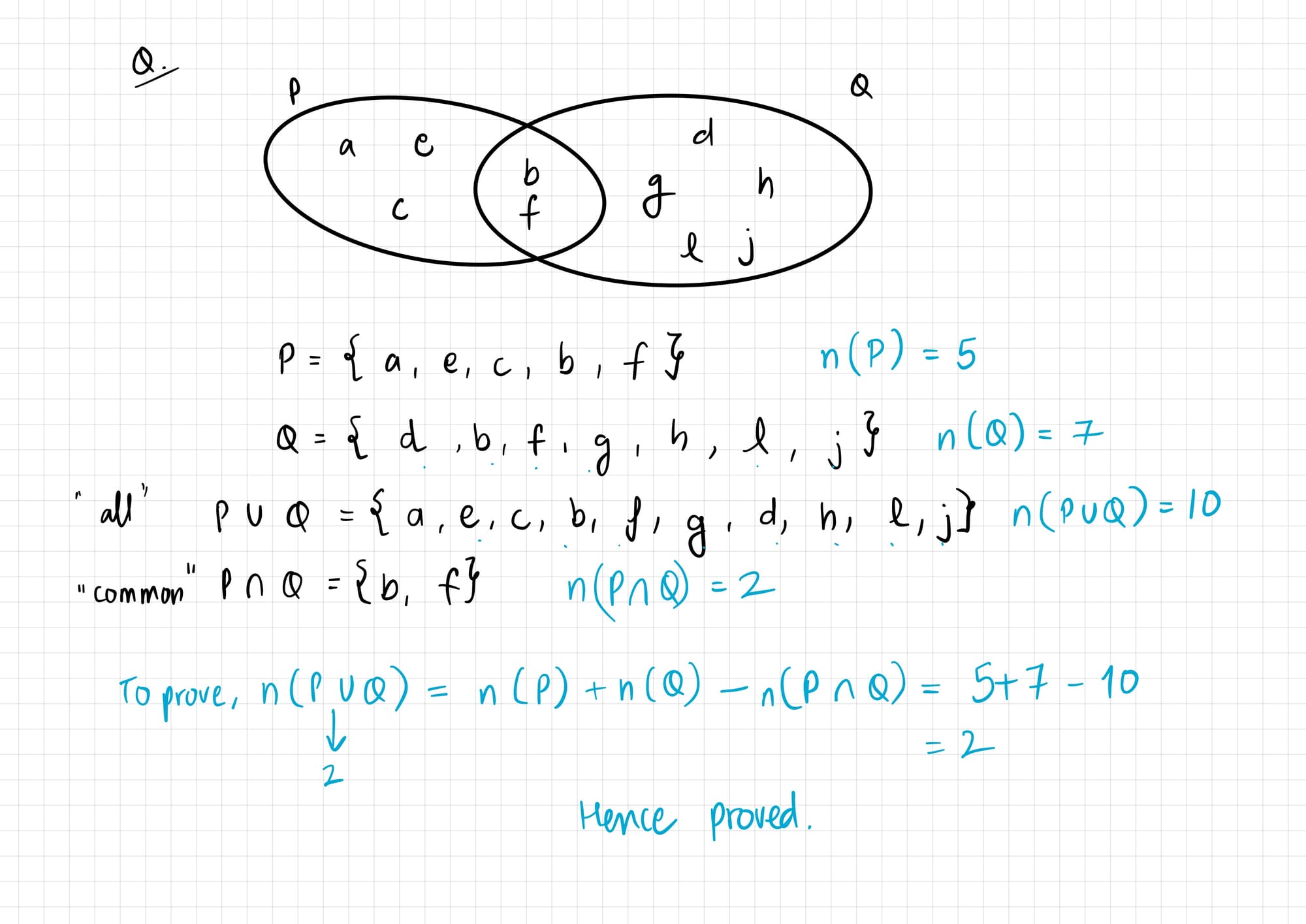
Cardinal Number represents the number of distinct elements in a finite set denoted by n(A). P={letters in QUEEN}= {Q, U, E, N} => n(P)= 4.
Two sets can be equal if they have the same elements.
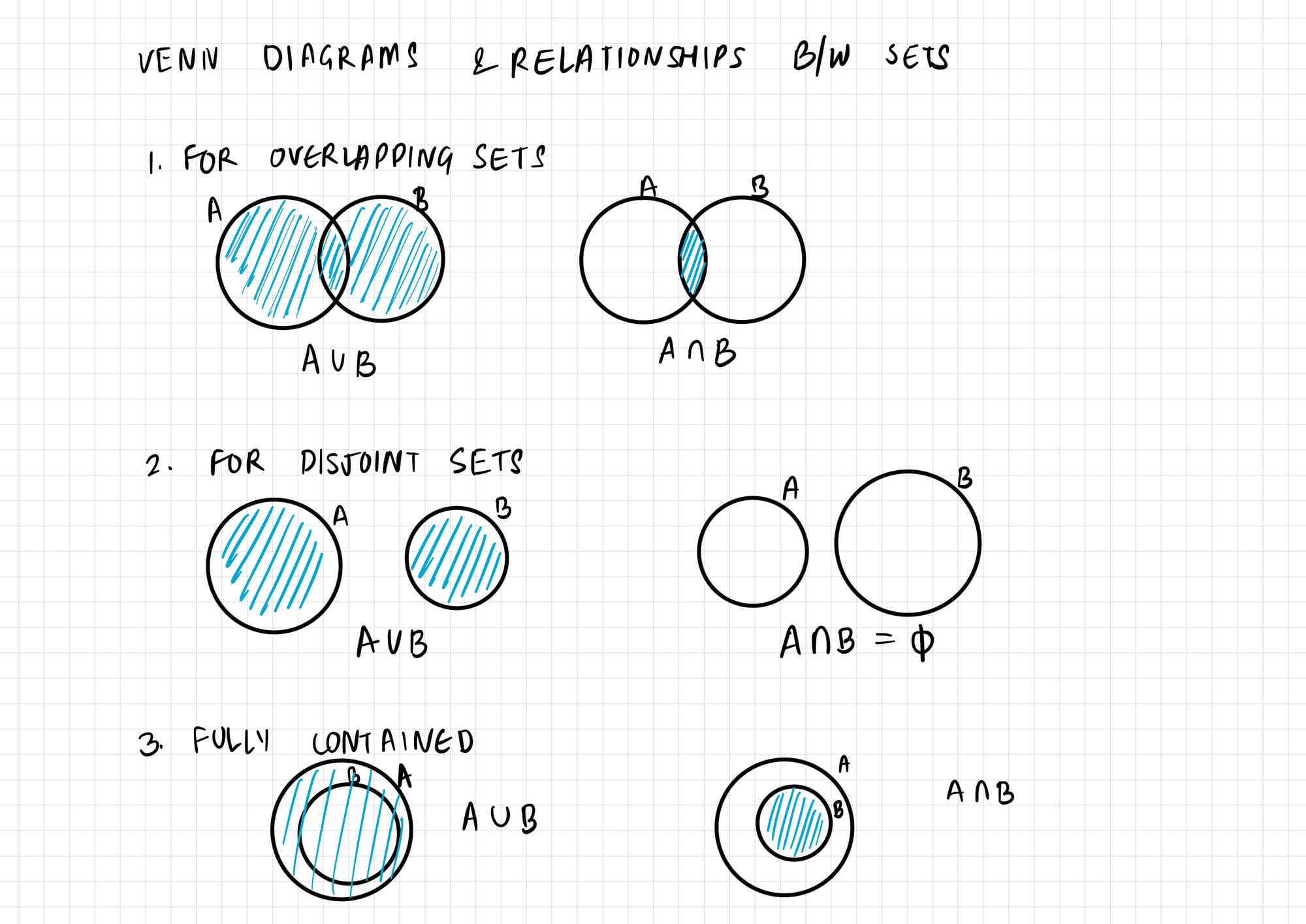
Union A ∪ B = all elements belonging to either A or B or both.
Intersection A ∩ B = common elements of A and B
Overlapping sets are sets which have at least one common element. Disjoint sets have no common elements.
John Venn used geometric figures- Venn diagrams to visualise sets and their relationships. Rectangles, squares, circles and ovals are used to show sets and points/marking inside represent elements.
2) Numbers, Factors and Multiples, Divisibility and Fractions, Power, Roots
(Significance: duh!)
Natural Numbers N={1,2,3,4......}
Whole Numbers W={0,1,2,3,4....}
Denary system -our counting system of base 10. ( 2345=2x1000 + 3x100 + 4x10 + 5).
The place/local value of a digit in a number depends on the place it occupies in the number. 543 - place value of 5 is 500, 4 is 40 and 3 is 3. The face value is the true/intrinsic value of the number. for 5 it's 5, 4 it's 4 and 3 it's 3.
Integers I or Z ={...., -3,-2,-1,0,1,2,3,....}
Integers are used to express statements in mathematical terms - profit/loss, deposits/withdrawals, Heights above/below sea level, temperatures above/below freezing point etc.
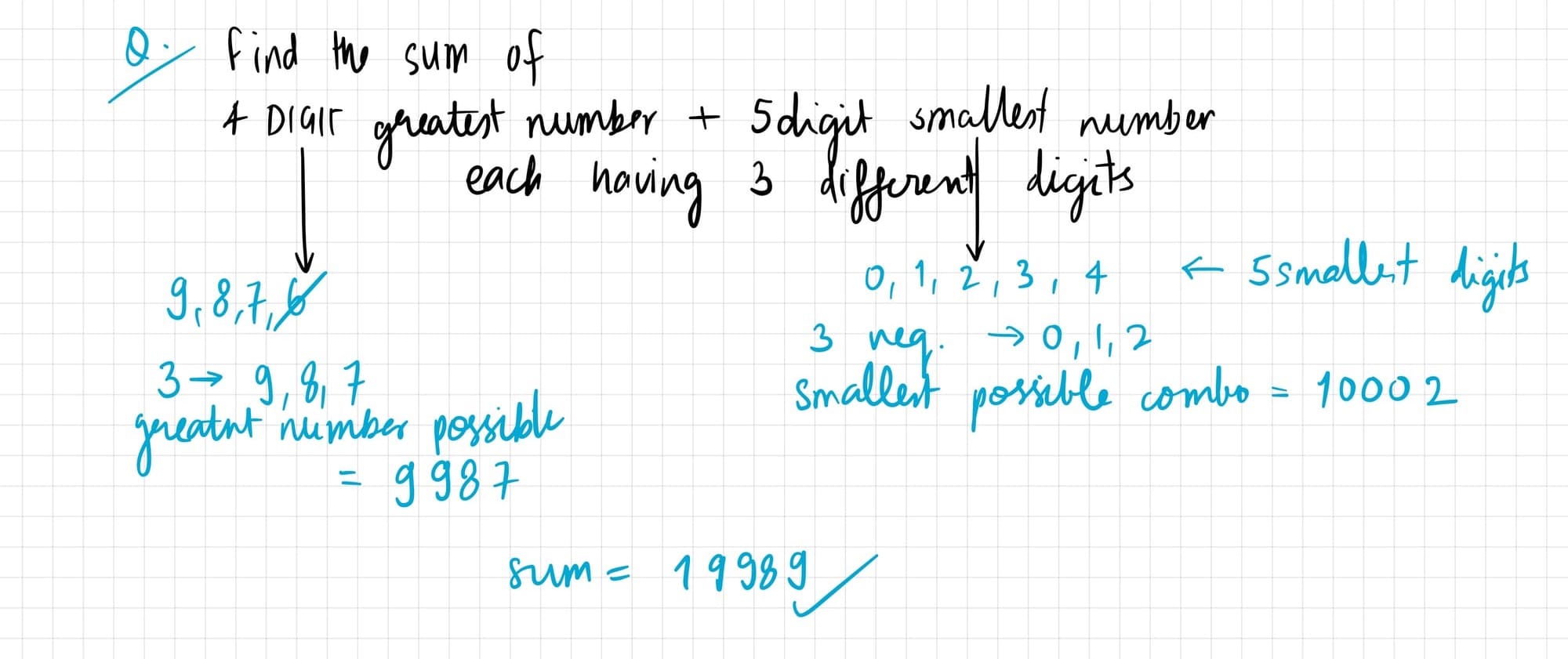
Order of performing Operations - BODMAS - Brackets, Of, Division, Multiplication, Addition, Subtraction
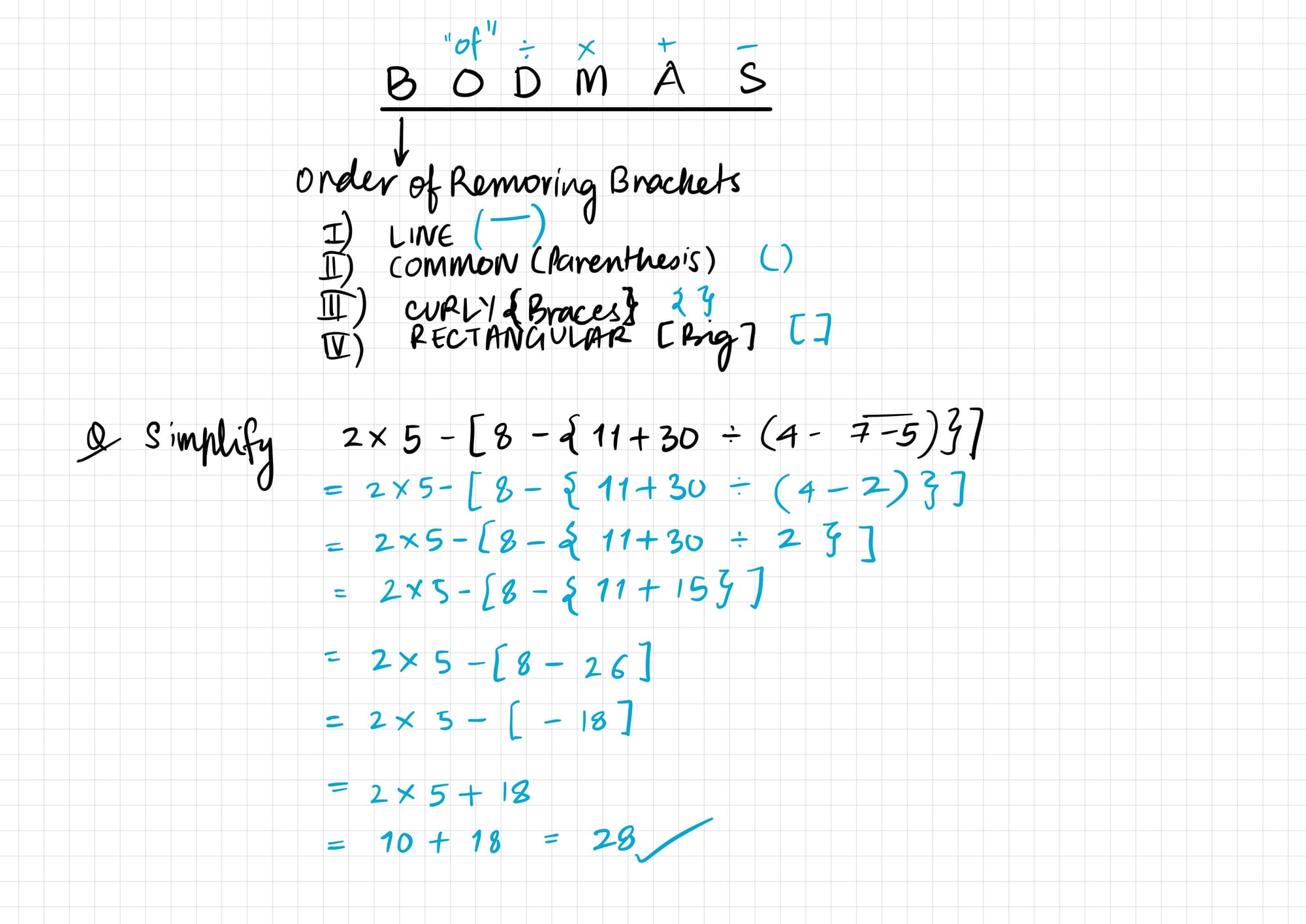
Product is the multiplication of two or more natural numbers. Factor or Divisor is a natural number that divides a given natural number. That given natural number is a multiple of the factor. For example, 3 and 4 multiplied is 12 (product). 1, 2,3, 4, 6 and 12 are factors of 12 and 12 is a multiple of each of 1,2,3,4,6 and 12.
Some factors facts - 1 is a factor of every number. The only factor of 1 is 1. Every number is a factor of itself and every number has at least two factors - 1 and itself. Every factor of a number is < or = the number. Every multiple of a number is > or = number. Every number has infinite number of multiples.
Even numbers are exactly divisible by 2. Odd numbers are not divisible by 2. If a number itself and 1 are the only factors of a number, it is called prime. A number with >2 factors is called composite. Two numbers are co-prime if they have no common factor other than 1 (Eg: 5,8/ 2,3)
Greek Mathematician Eratosthenes gave a method - Sieve of Eratosthenes to find prime numbers.
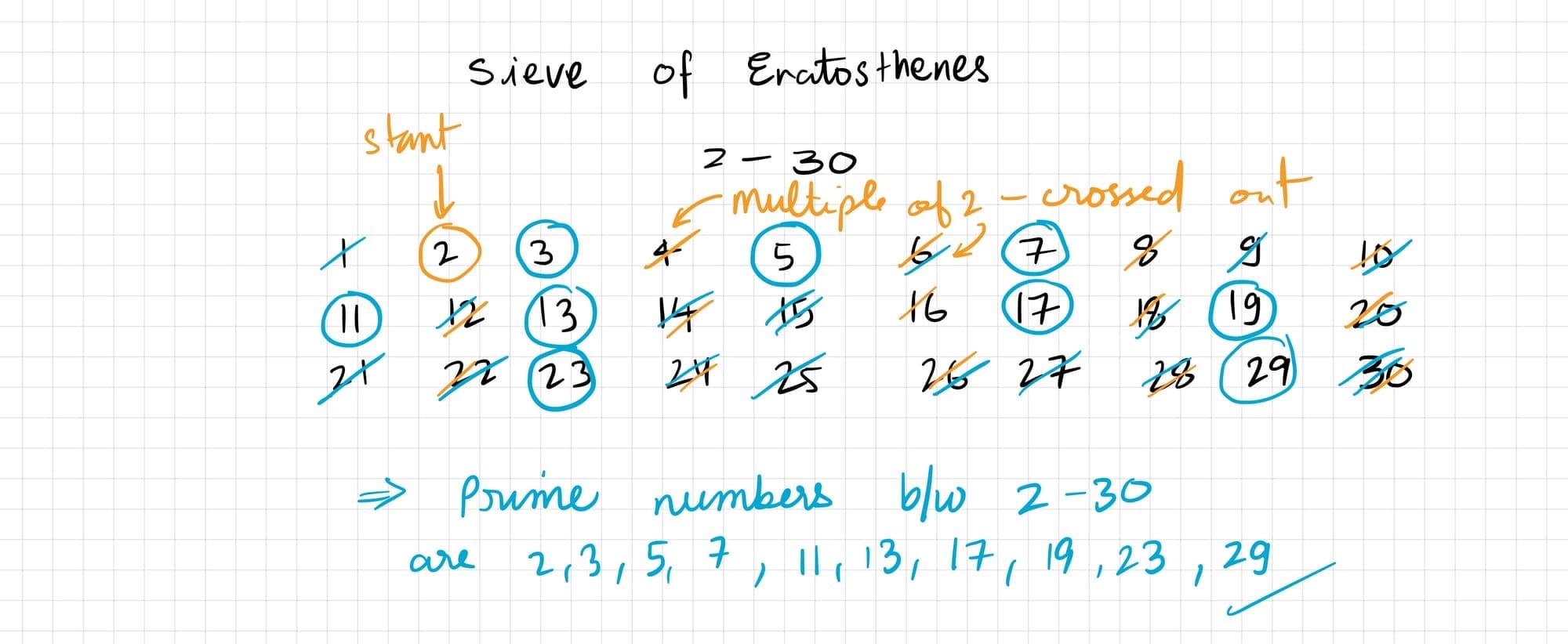
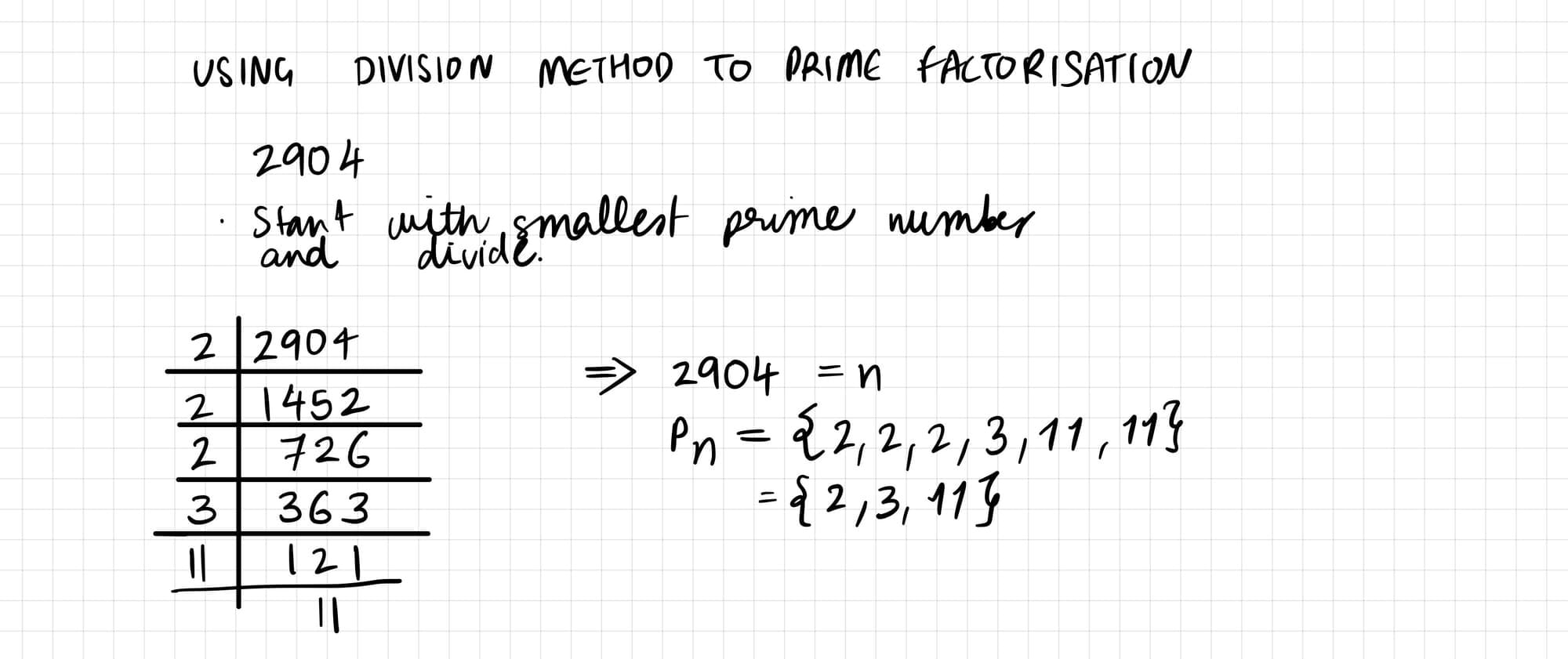
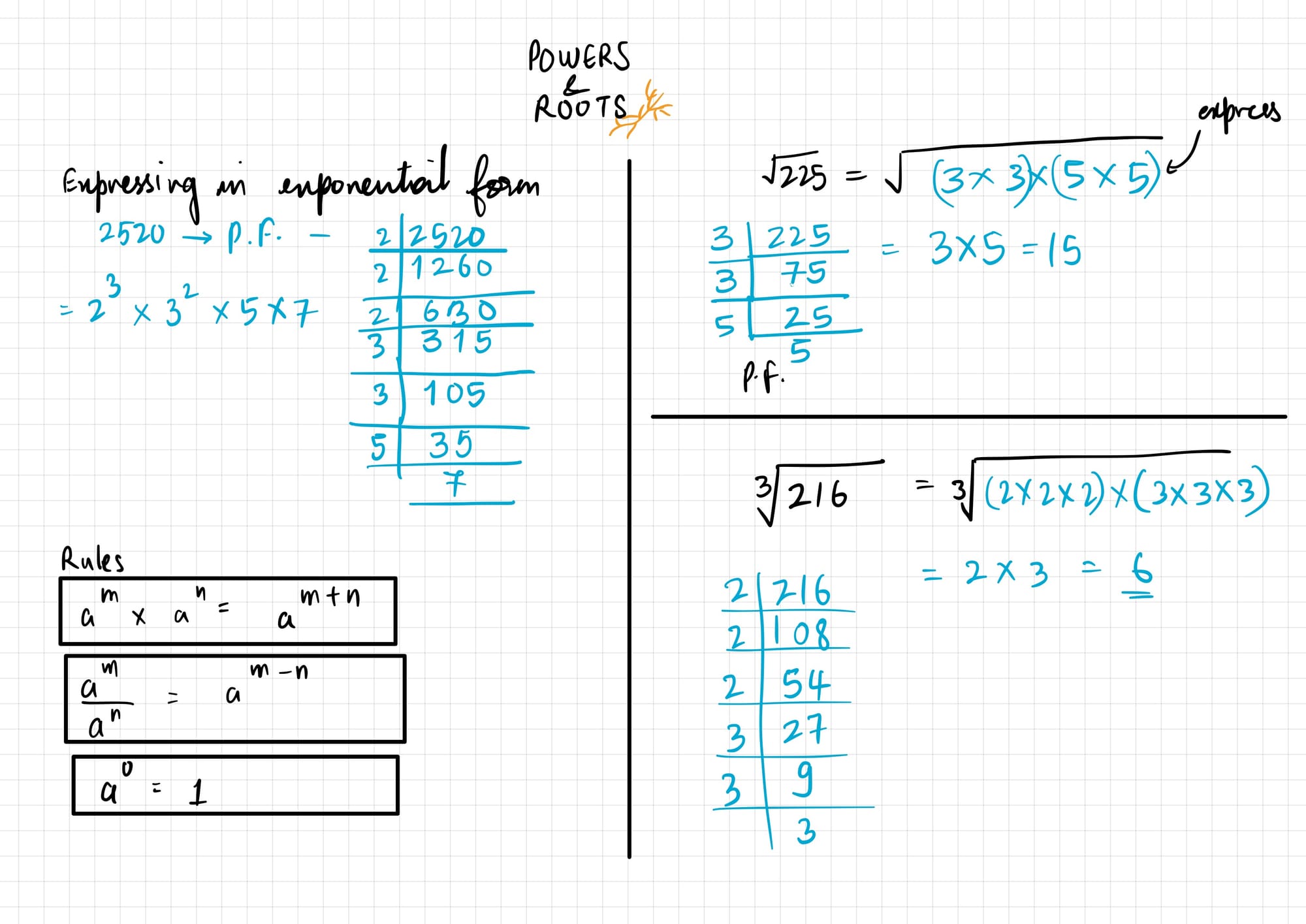
Prime Factorisation - expressing a natural number as product of prime numbers.
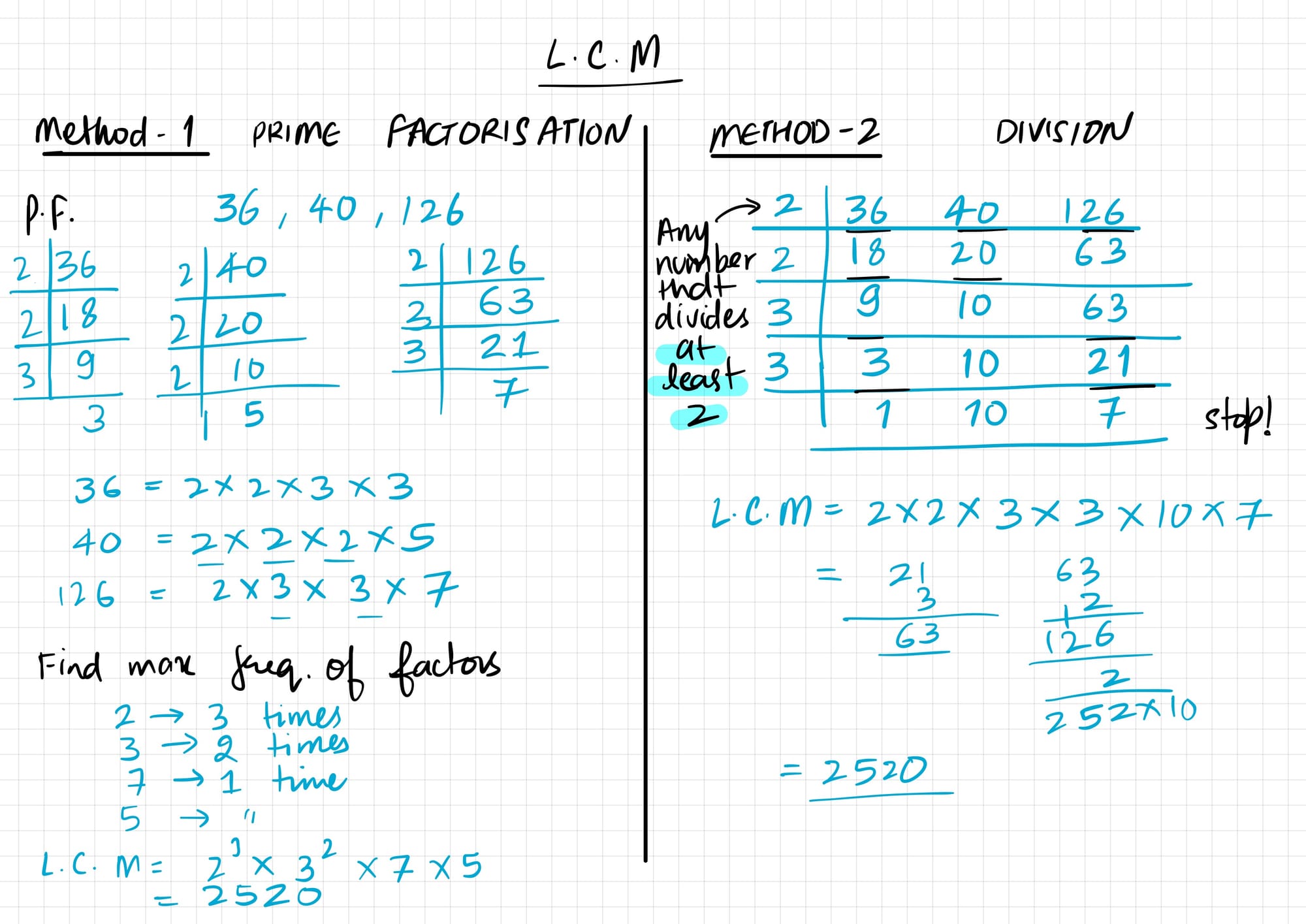
Least Common Multiple- L.C.M. of Two natural numbers is the smallest natural number which is a multiple of both the numbers.
Highest Common Factor - H.C.F. of two natural numbers is the largest common factor or divisor they have.
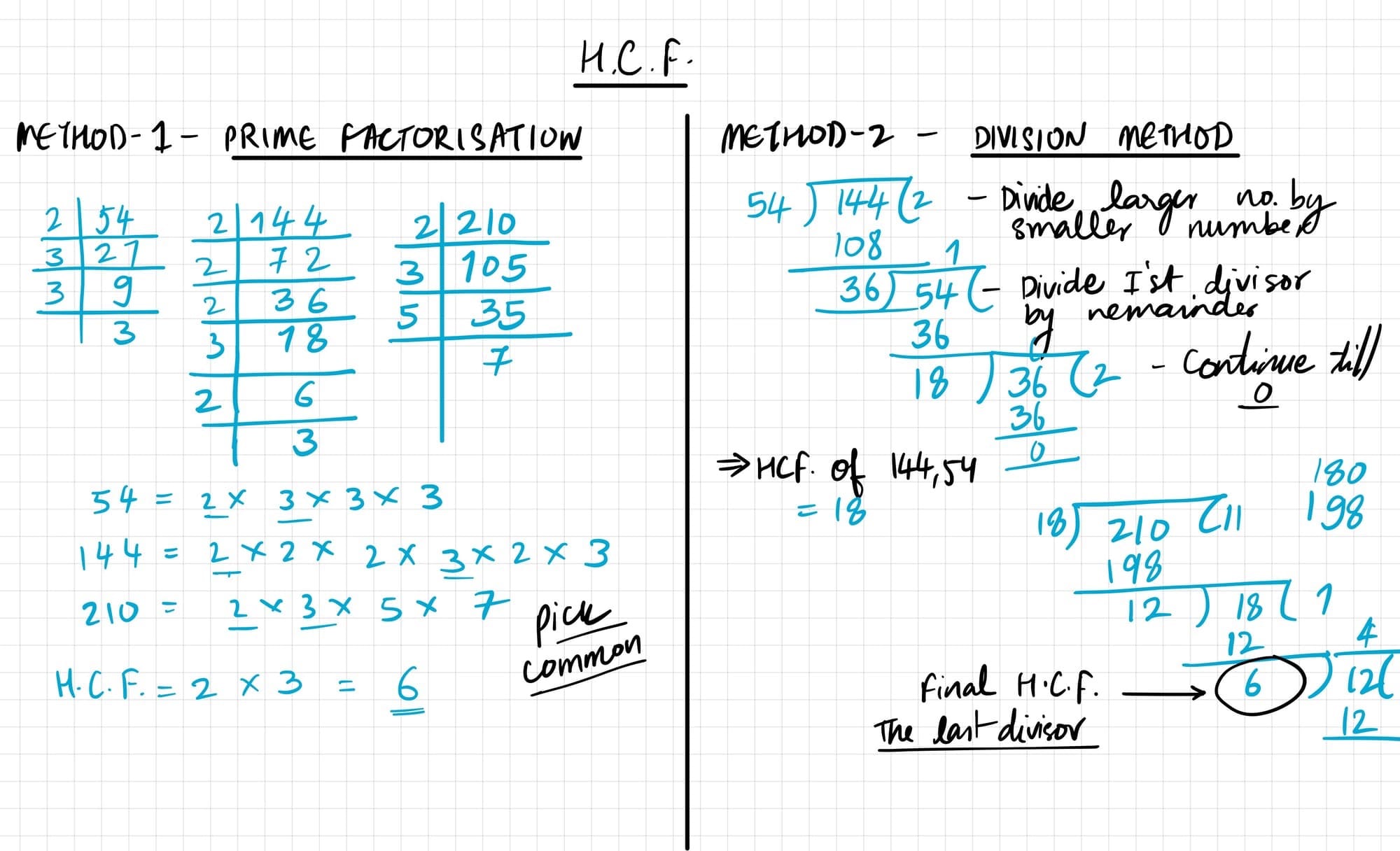
Relationship between HCF and LCM - Product of two numbers = Product of their HCF and LCM.
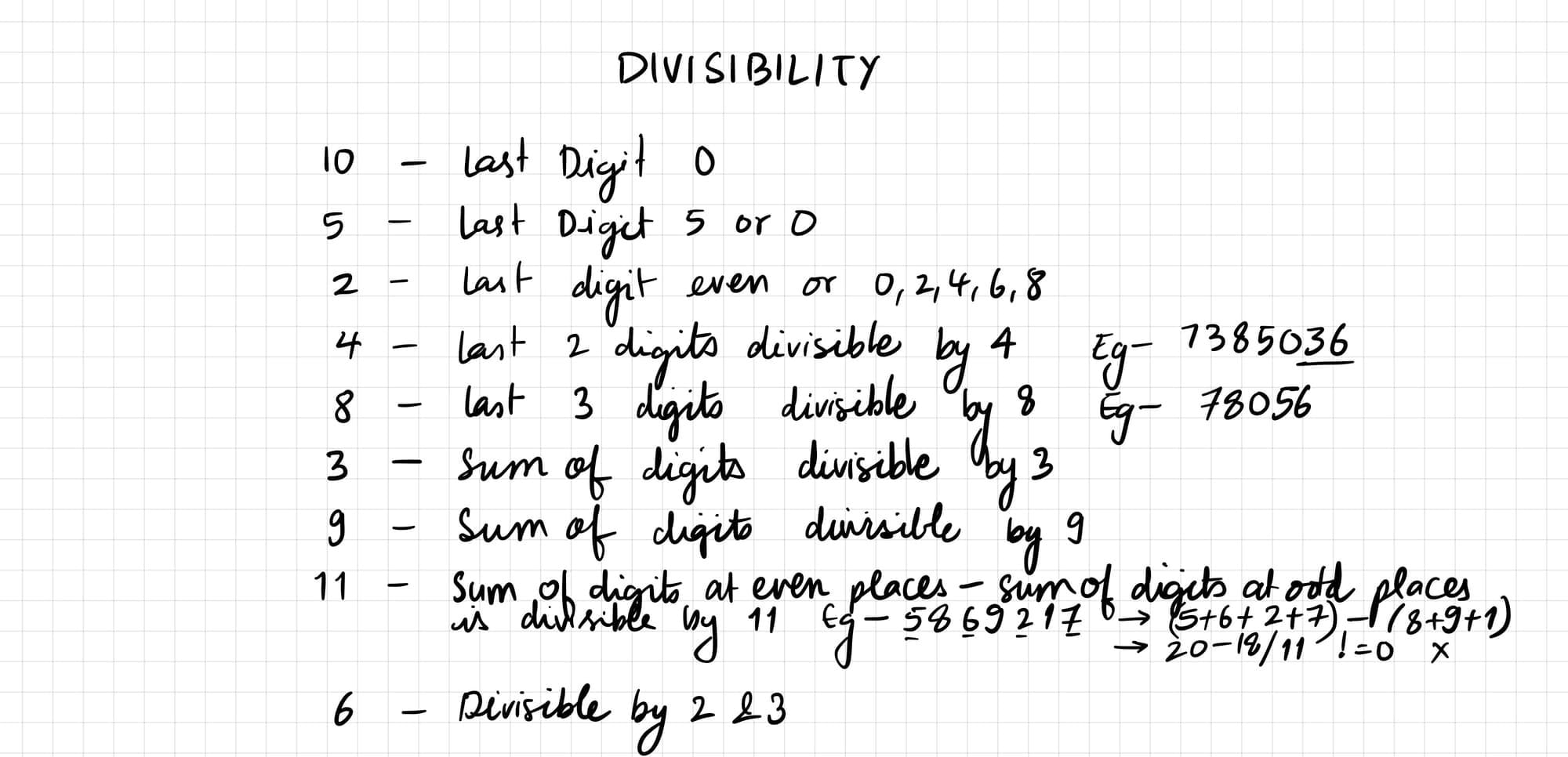
Common Divisibility tests -
Fractions and its types - Proper, Improper, Mixed. When the numerator is >0 but <denominator, the fraction is called proper (13/128). When the numerator is > or = denominator then it's an improper fraction(9/4). Every natural number is an improper fraction. A natural number, and a proper fraction put together makes a mixed fraction 9 3/4 (or 9+ 3/4). Every mixed fraction can be represented as a improper fraction and vice versa.
Fractions lying between -1 and 0 are called proper negative fractions(-5/7) and those less than or equal to -1 are called improper negative fractions (-31/7).
Fractions having the same denominator are called like fractions. (3/4, 5/4)
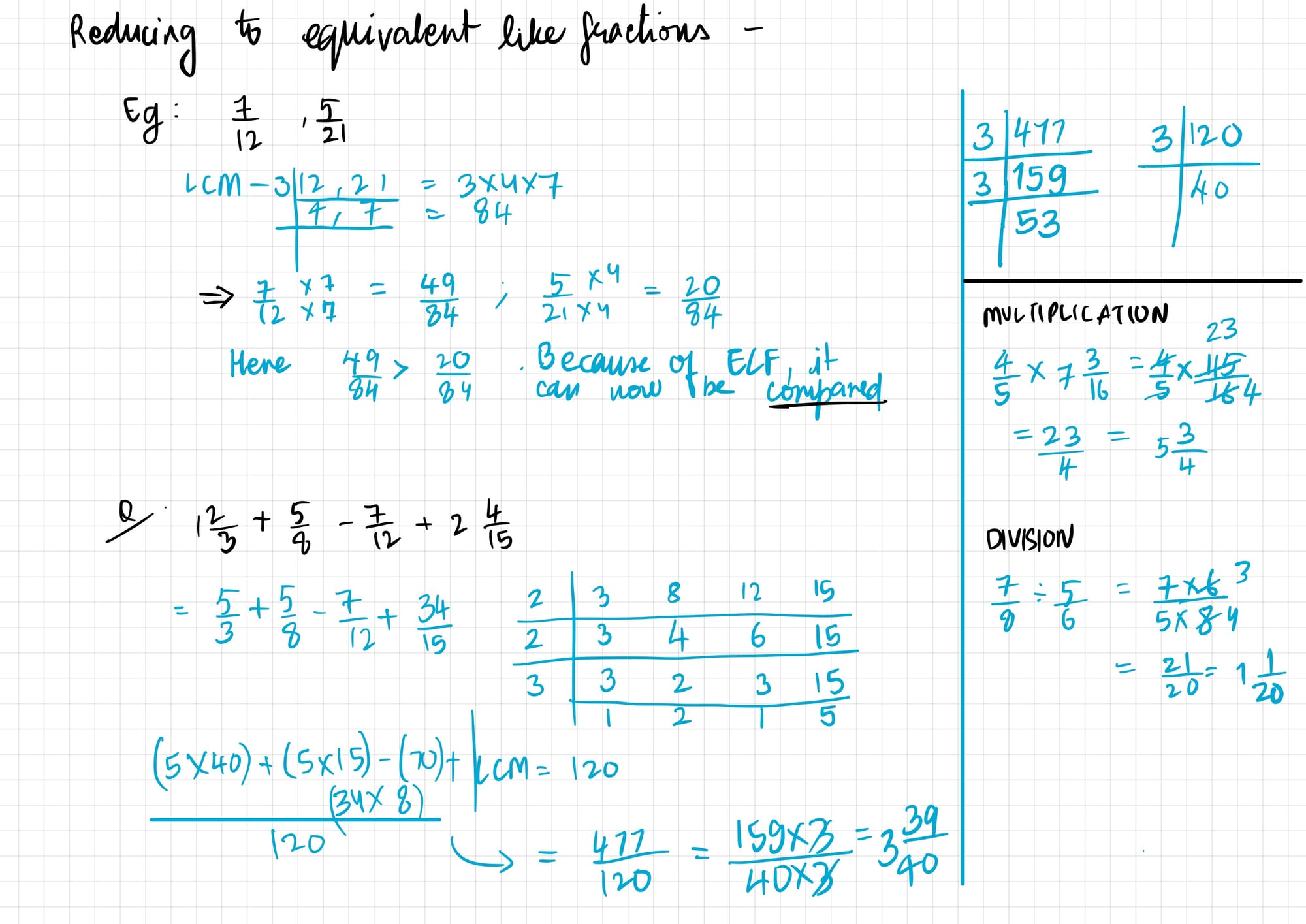
Equivalent fractions and reducing fractions to equivalent like fractions-
Fractions having the same value are called equivalent fractions. Eg: 1/2, 2/4, 3/6 etc. The value of the fractions do not change when numerator and denominator are multiplied or divided by the same non-zero number. Cancelling is the process of diving the numerator and denominator of a fraction by the same number.
When the numerator and denominator has no common factor other than 1- it is said to be in its irreducible form or simplest form. The simplest way to achieve this is to prime factor both and cancel out.
Decimals to Fractions and Vice versa. 0.013 can be written as 13/1000. To convert 5/4 into decimals, we must change the denominator to base 10. 5x25/4x25 =125/100 =1.25
A number 'a' multiplied by itself is its square or power of 2. The number multiplied by itself thrice forms its cube. Square root and Cube root gives the original number back respectively.
3) Ratios and Proportion, Profit Loss, Simple Interest
Ratios are used to compare two quantities of a same kind. In ratio a:b read as "a is to b", first term a is called the antecedent and second term b is called the consequent. Ratio is a fraction. It has no units.
An equality of two ratios is called a proportion. We can say that four quantities a, b, c, d are in proportion if a:b= c:d also written as a:b :: c:d read as "a is to b is as c is to d" . Here, terms an and d are extreme terms (extremes) and b and c are middle terms (means). Cross Product rule says that product of extremes = product of means => ad= bc and this being true signifies proportion exists. If ad≠bc then a,b,c, d are not in proportion.
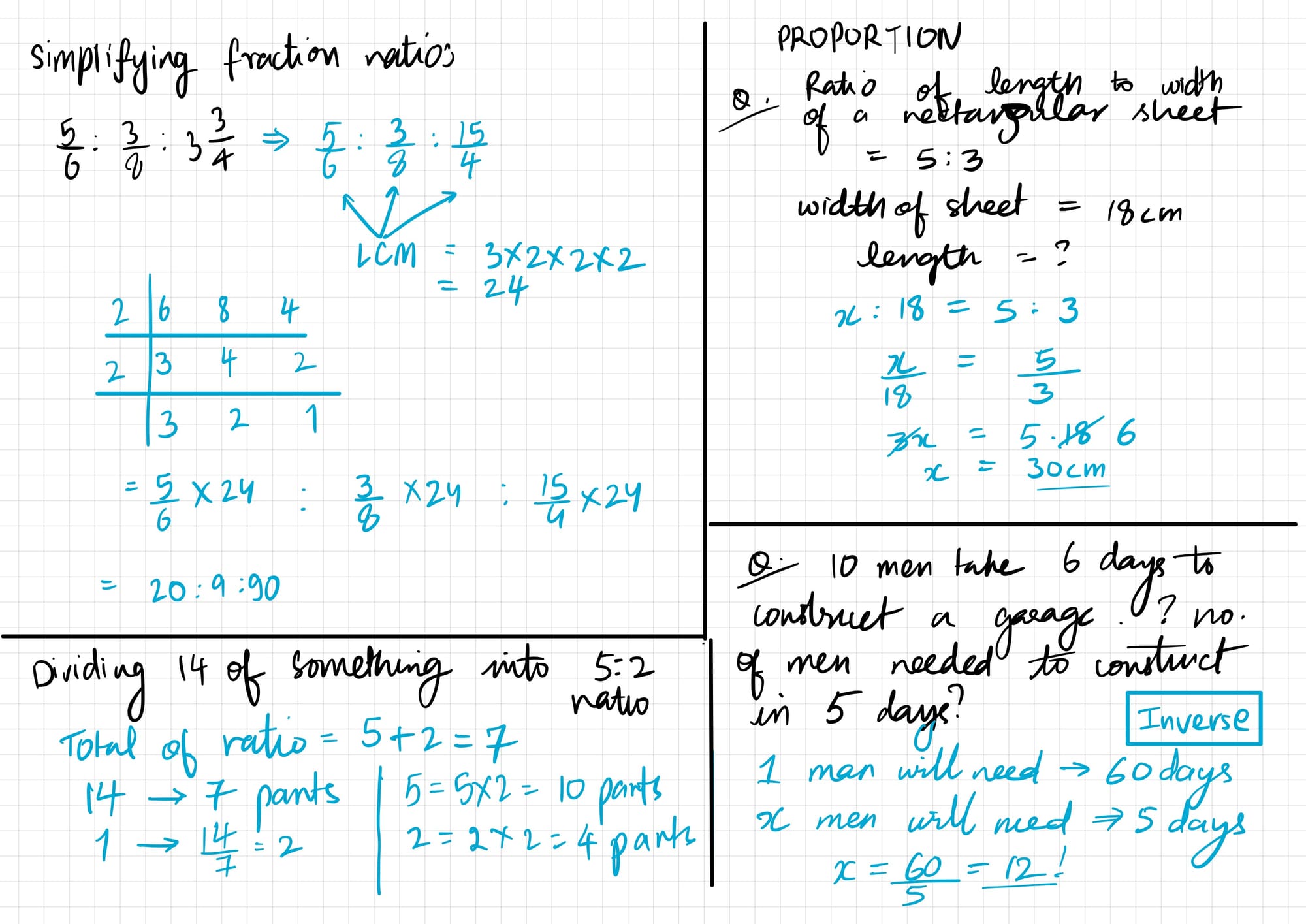
Unitary method - A method in which the value of a unit quantity is first found out to calculate the required quantity. Sometimes two quantities vary directly - if increase/decrease in one quantity causes the other to change proportionally. Other times, they may wary inversely - increase in one quantity decreases the other and vice versa.
% means out of hundred. So 25% is 25 of hundred. Percentages are used to express one quantity as a percentage of another. Like Profit and Loss.
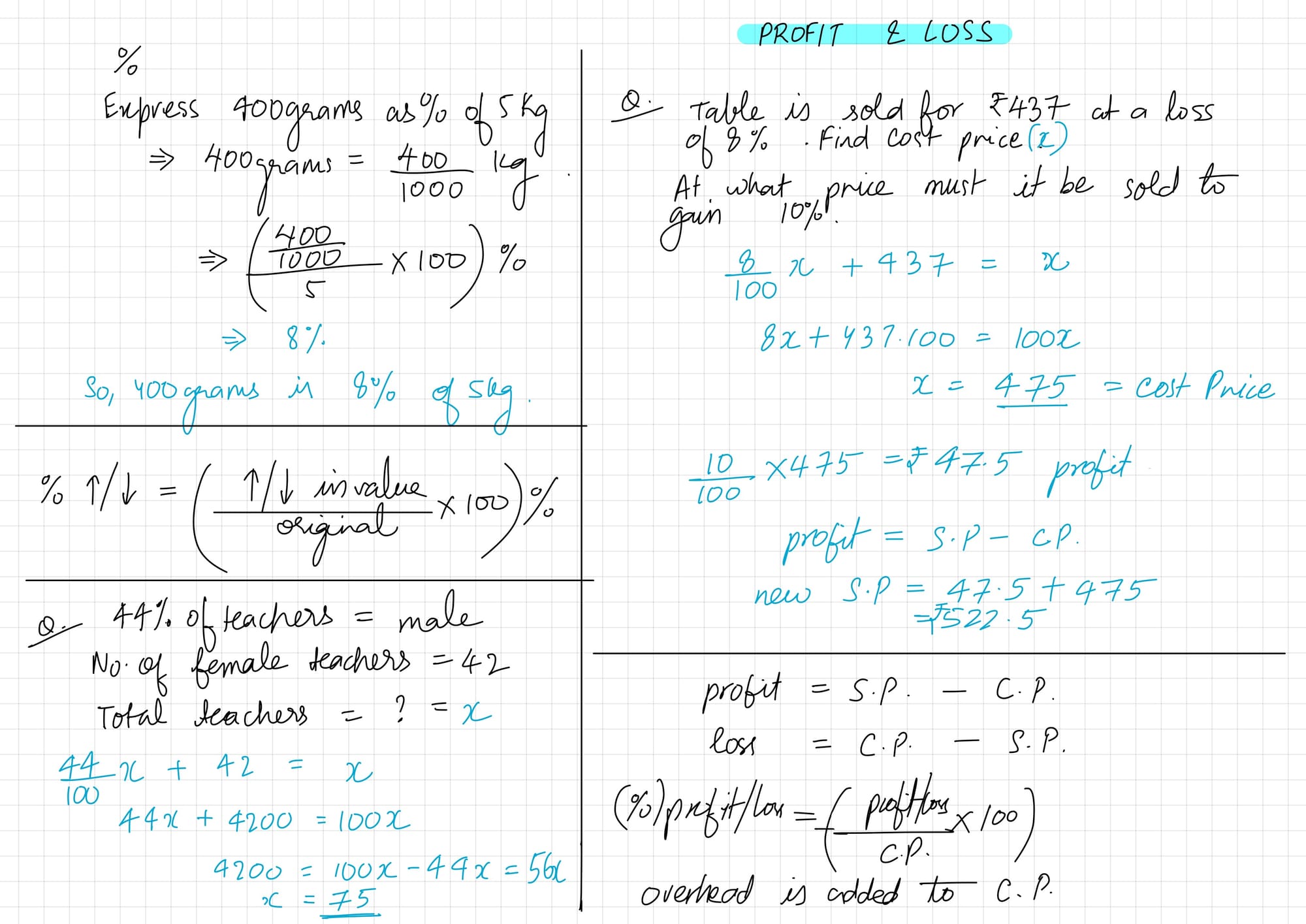
Interest is the added amount on the principal due to passage of time. Principal amount is the money borrowed or lent. Amount is the total money paid= Principal +Interest.
Rate is the interest paid on Rs 100 for 1 year. Simple interest is calculated on the principal amount, at a given rate for a given period.
I= PxRxT/100
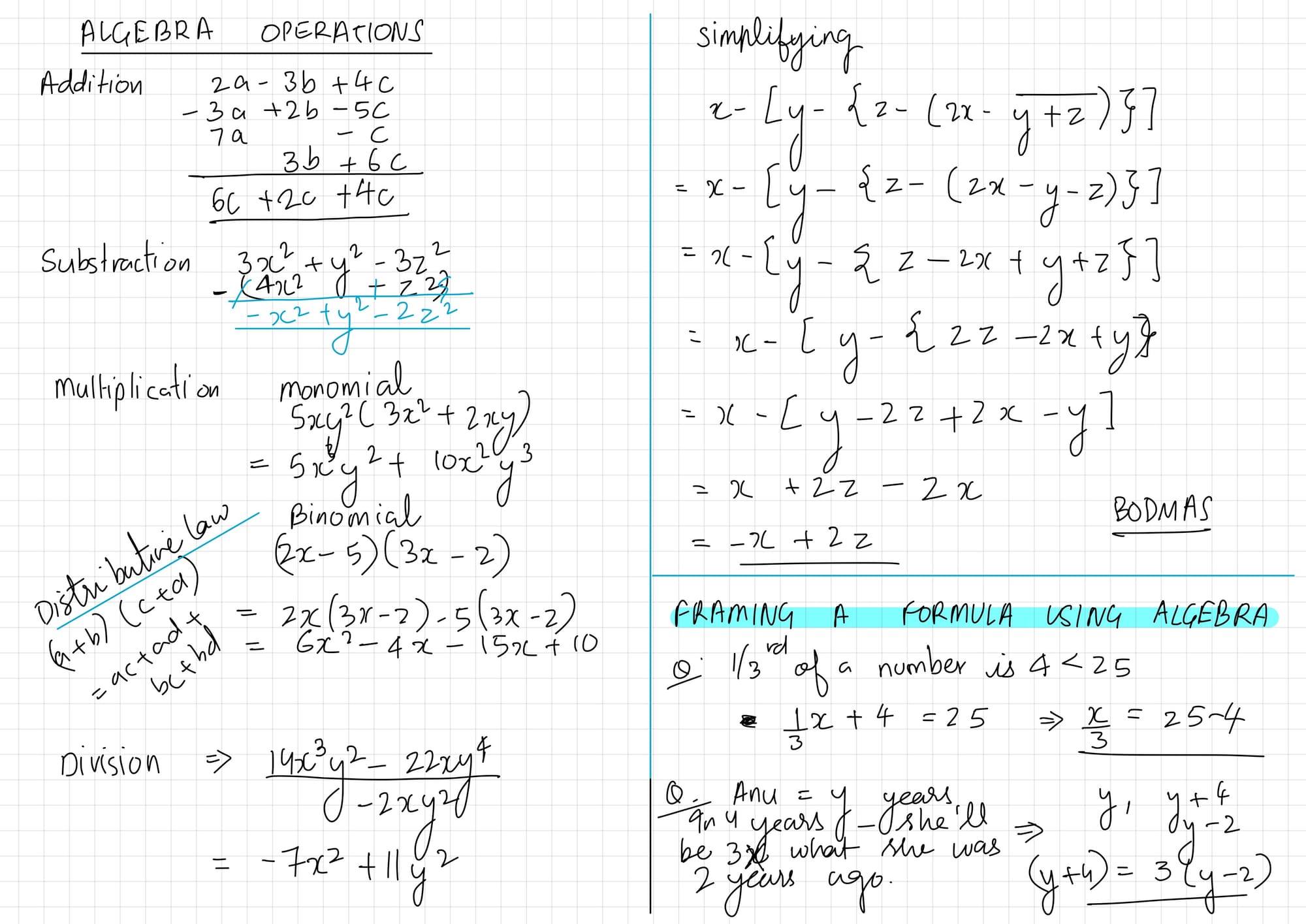
4 ) Algebra (Concepts, Operations, Substitution, Linear equations, Making formulas)
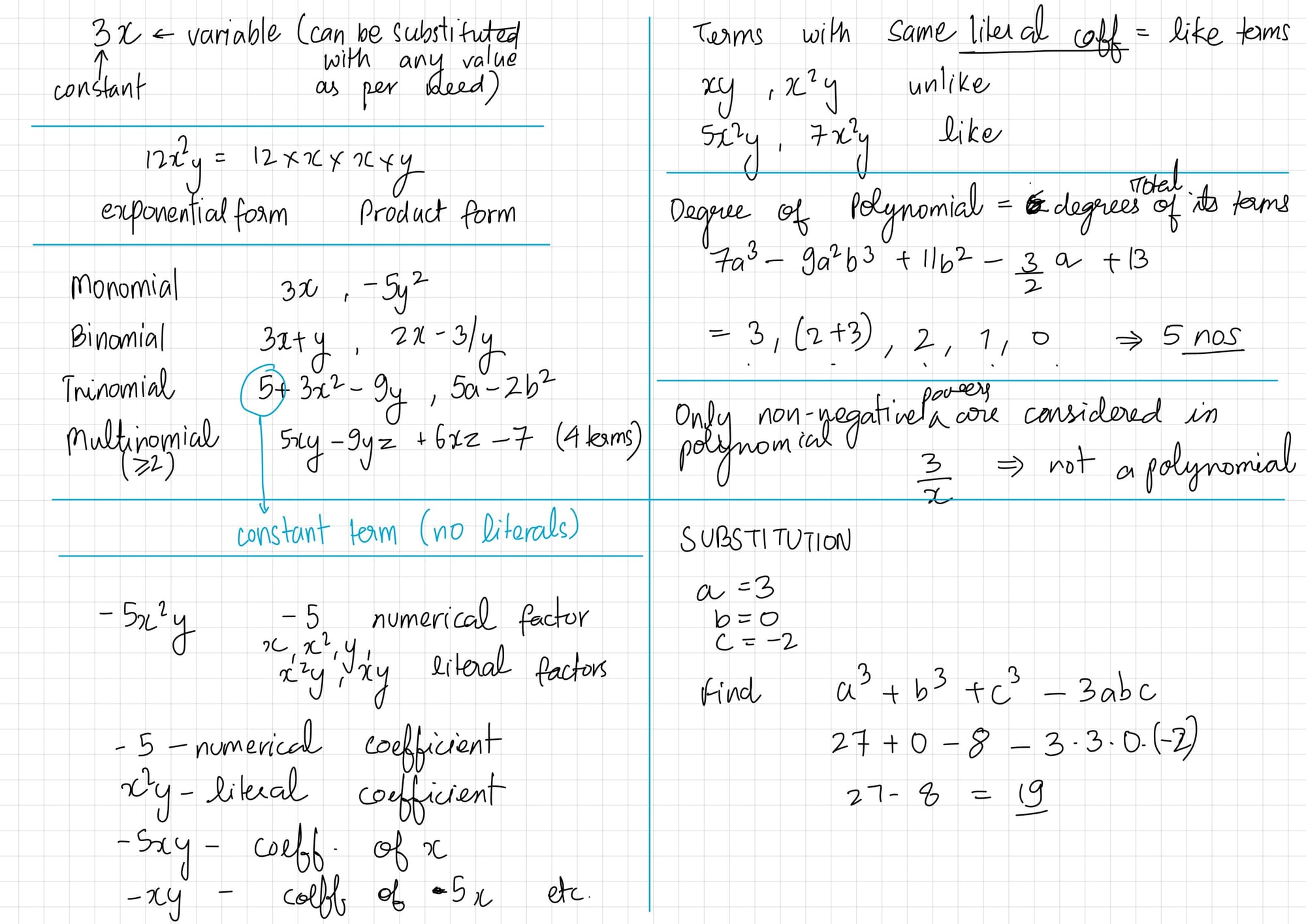
Algebra uses letters (called variables or literals) to perform arithmetic processes.
5) Geometry (Concepts, Lines, Angles, Types Properties, Construction, Triangles, Circles, Symmetry)
Point - No length, no width, no thickness, just a point holding position and whose location can be ascertained.
Line - extends indefinitely in both directions. Has only length, no breadth, or thickness. Has property of straightness.
Plane - flat surface having length and breadth but no thickness. Extends indefinitely in all direction.
Points and Lines have relations in a plane- Incidence properties.
Unlimited number of lines can pass through a given point. There's exactly one line passing through two distinct given points in a plane. Two different lines in a plane either intersect at exactly one point or are parallel. Two different planes are either intersecting or are parallel. If they intersect, they do so in a line.
Points (3 or more) lying on the same line are called collinear and those not lying on the same line are called non-collinear points. The line of collinear points is called line of collinearity. Two or more lines in a plane are called concurrent if and only if all of them pass through the same point, and the point is called the point of concurrence.
Rays (line sun rays, light rays from bulbs) starts from a fixed point and extends indefinitely in one direction.
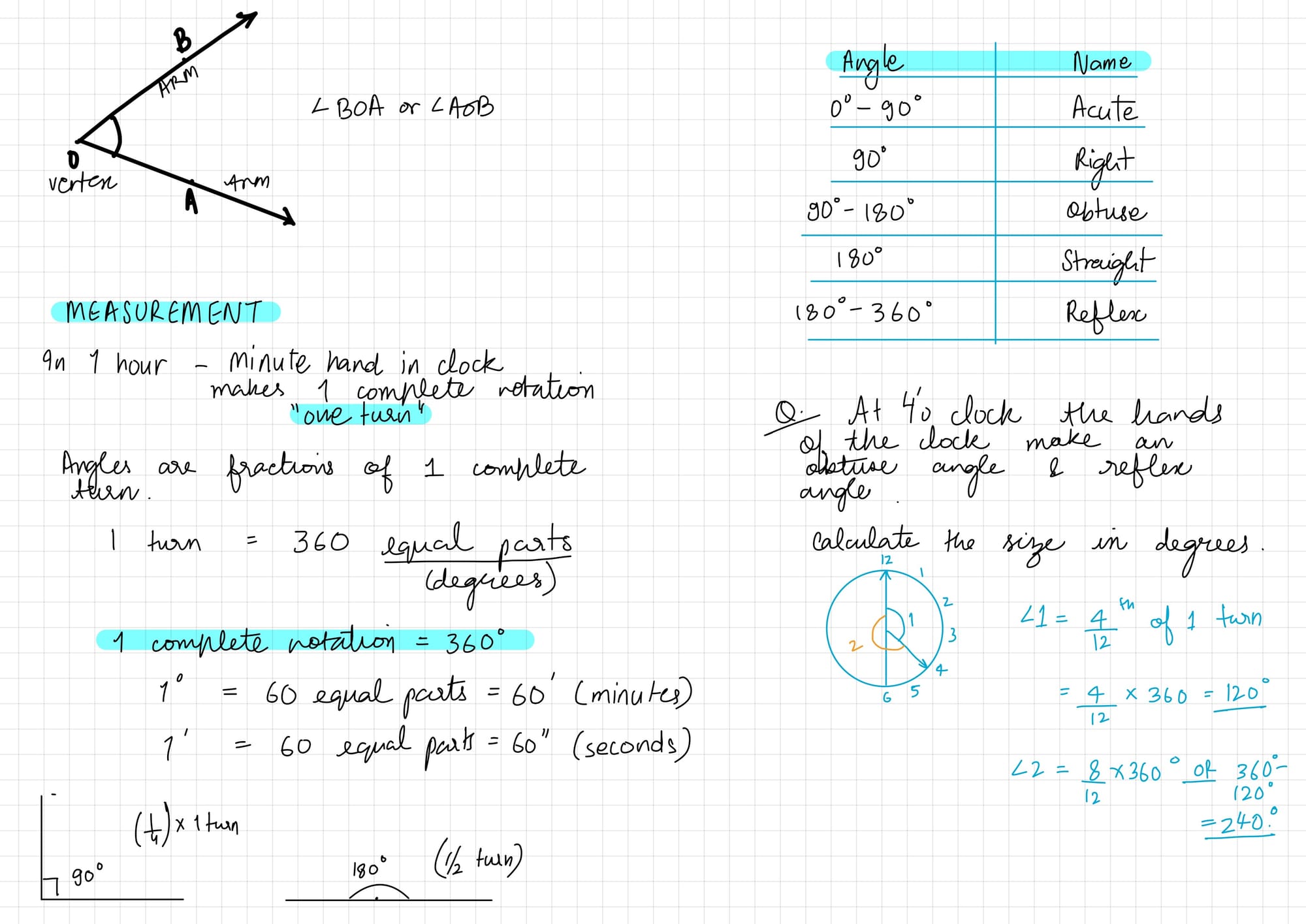
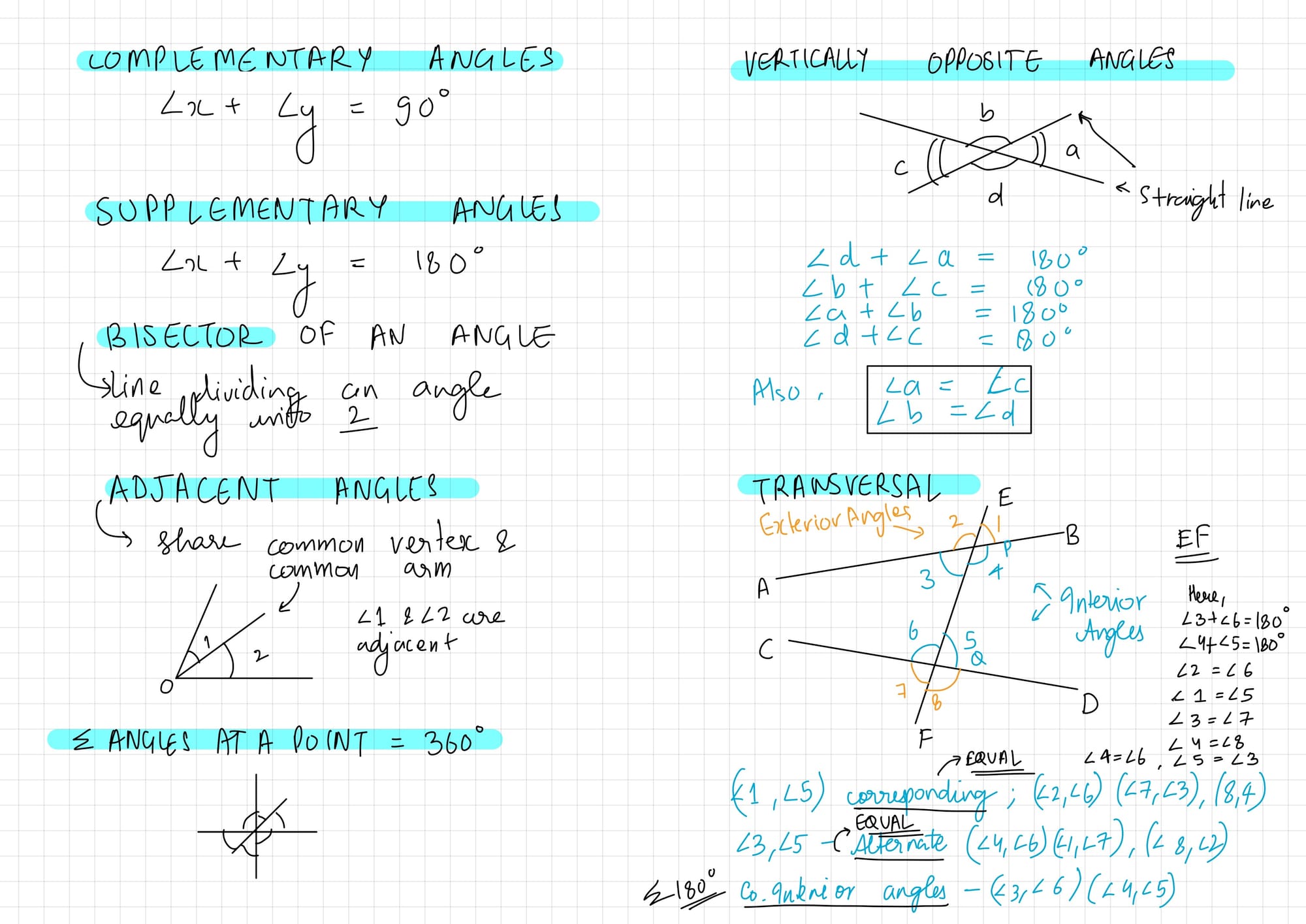
Angle - Angle is formed by two rays having the same initial point.
Comments ()